
So you wanna grow some of that gorgeous Persian shield. Did you see it at the nursery and it struck you into a trance with those purple tones?
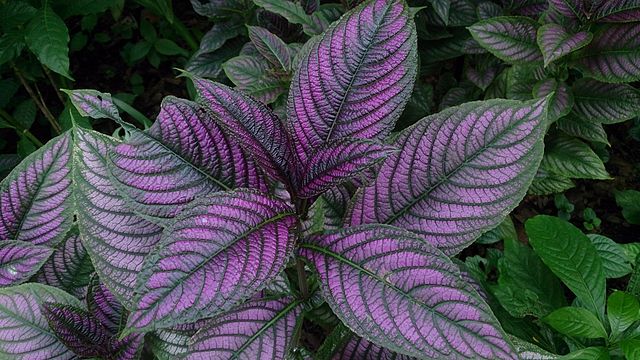
S. dyerianus is known for those shining purple iridescent leaves with silver slivers.

It’s an exotic looking plant straight out of Myanmar.
But it can easily be grown in your home office or garden with little effort. Seriously.
Let’s dive in and learn how to grow and care for Persian shield.
(Featured image By Mokkie – Own work, CC BY-SA 4.0)
Last updated: 6/23/22.
Guide Contents
Quick care guide: Persian shield
| Plant type | Evergreen, annual, perennial |
| Origin | Myanmar |
| Scientific name | Strobilanthes dyerianus |
| Other names | Royal purple plant |
| Soil type | Fertile, loamy, well-draining |
| Soil pH | 5.5-7.5 (slightly acidic to neutral to alkaline) |
| Sunlight requirement | 6-8 hours, full sun or partial sun |
| Bloom season | Persian shield doesn't bloom |
| Colors | Purple, maroon, green |
| Max height | 5 feet |
| Max width | 3-5 feet |
| Low temperature tolerance | 60F |
| High temperature tolerance | 80F |
| Ideal temperature range | 70-80F |
| Humidity | High, 100% |
| Watering requirements | 2-3" per week |
| Fertilizer requirements | Moderate feeding during spring, summer |
| Plant food NPK | 5-5-5 or 10-10-10 |
| Days until germination | 2-4 weeks |
| Days until bloom | Persian shield doesn't bloom |
| Speed of growth | Moderate |
| Hardiness zones | 8, 9, 10, 11 |
| Plant depth | 0.25" from seed, 3-4" from softwood stem cuttings |
| Plant spacing | 3-4 feet between each plant |
| Plant with | Fern plants, Lambs Ears, ficus, potato vine, caladiums, plectranthus, and impatients |
| Don't plant with | Plants in the same family |
| Propagation method | Seeds, cuttings |
| Common pests | Spider mites, fungus gnats, soil mites, aphids |
| Common diseases | Fungus, gray mold, leaf spot, anthracnose, powdery mildew, root rot |
| Indoor plant | Yes |
| Outdoor plant | Yes |
| Grown in container | Yes |
| Flowering plant | No |
| Beginner friendly | Yes |
| Care level | Low (easy) |
| Best uses | Decoration, houseplant, bordering, background plant, foreground plant, pathing plant, potted plant, houseplant, office plant |
What’s Persian shield?
Persian shield, scientifically known as Strobilanthes dyerianus, is a gorgeous Acanthaceae with purple leaves.
If you’re looking for a plant that really emits a glow and draws attention, Persian shield will do the trick.
This ornamental plant comes from Myanmar, where its’ always humid and warm. It grows as an evergreen that comes back every season so you can enjoy it time after time without having to buy it again at the nursery.
It is a flowering plant, but I think the leaves are more interesting than the flowers.
That’s how gorgeous they really are.
Under the right lighting, they almost emit a glow with their textured surfaces rigid with purple, dark green, and lime.
The phenomenal leaves give flowering plants a run for their looks.
Each plat produces leaves up to 7 inches with tipped edges and green veins. The leaves are purple and silver with a bushy appearance and can grow up to 5 feet tall.
The plant looks exotic, cool, and makes an awesome addition to the outdoor garden or household plant. Imagine putting one of these in your office.
Let’s learn more about these mysterious shield plants.
Is Persian shield poisonous to cats or dogs?
There is no concrete evidence that Persian shields are toxic.
The same goes for pets, like cats and dogs.
People have said that they had some skin irritation from the plant sap, so take that as you will.
If you’re concerned about poison, use gardening gloves, keep pets/people away, and exercise caution when handling Persian shield.
Is Persian shield easy to grow?
These plants are very basic, which makes them perfect for beginners.
Other than regular watering, pruning, and basic TLC, they don’t ask for much.
The 5-inch purple leaves are pretty to look at with a dash of silver.
These plants don’t grow too tall or wide, so they can be a centerpiece in a compact tiny garden.
Annual or perennial?
Persian shield is an evergreen plant in nature.
When planted in the right hardiness zone, it can be grown as a perennial. Even though it drops its leaves, the root system remains intact.
Persian shield naturally loses its leaves in the winter and will grow once again in the spring.
For extremely cold zones, it can be brought indoors to overwinter.
Otherwise, it’ll be grown as an annual, which is a waste since you can enjoy it over and over if you keep the temperatures above 60F or so.
How to grow Persian shield
This section covers the general guidelines for growing and caring for Persian shields.
Depending on where you’re located, the type you’re growing, and your local climate, instructions vary.
You can utilize these tips to get an overall idea of how to care for it. The silver/purple leaves make it more colorful than flowering plants themselves. They also provide color all year round if temperatures are kept warm and the air is humid.
Hardiness zone
Persian shield grows in USDA zones 10-11.
It’s a limited scope because it’s native to Myanmar where it’s humid and wet.
It can be grown indoors if you really want to get some of that purple leaf love, so you have options even if you’re not in the right hardiness zone.
However, for folks that want to grow it outside, it’ll be easier if you’re in the right zones.
If you’re growing Persian shield in a cooler zone, such as zones 8 or 9, the plant will slowly wither. This plant doesn’t like the cold and is a warm weather, humid, and subtropic species.
Even if the foliage dies back in the winter, the roots remain intact.
The plant will come back in the spring, as it’s a perennial.
So don’t pull those roots out just because your plant is wilting it’s pretty flowers.
Consider growing in a container if you’re in a cooler zone.
This way, you can move it indoors in the wintertime to keep those precious purple leaves and grow them as an evergreen.
Propagation
Propagating Persian shield is the hard part.
Once you get it going, it’s easy street from there.
There are multiple ways you can propagate it: by seed, cutting, or transplant.
Of course, like any other plant, buying a transplant is the easiest way.
If you’re new to gardening, this will be the least amount of work and you can enjoy your Persian shield right away.
For that with more experience, you can use a stem tip cutting from a friend or you can start from seed.
From seed
I’ll be frank- if this is your first time growing for Persian shield, you should use stem cuttings instead.
Starting from seed is a lot more work and it has specific conditions for germination. But if you’re up for the challenge, here’s how:
Get a fresh packet of seeds. Read the directions. They supersede any directions you read online since they’re written exactly for that plant rather than generic info from blogs.
Seeds should be sown in the spring or late winter.
Seeds will require at least 60F to germinate.
Get a seed starter and put 2-3 seeds per compartment. Each seed should be 0.25” deep. Use rich and moist soil. Water and cover with the humidity tray. Keep temperatures stable as seeds will NOT germinate when temperatures dip too low.
Seeds will germinate within 2-3 weeks. Thin to the strongest plant. Move to your garden or into a container when you notice a few pairs of leaves grow out.
Watch for signs of infestation, mold, or fungus. Dispose of infested plants.
From cuttings
If you have an existing Persian shield or you can get a soft stem cutting from a friend (softwood cuttings), you can propagate it that way. Get a sterilized pair of pruners and make a five-inch cut on the stem on the growing end.
This should be done before blooming. But if blooming has already taken place, wait until it sheds its flowers.
Cut 0.5 from the leaf nodes on fresh stems. This will increase the chance of rooting. Cut off any leaves from the bottom few inches so it’s leafless at the base. Don’t worry about the top half.
Rooting in water
Prepare a clear vessel for indoor rooting.
It should be glass so you can see through it easily. It makes checking for fungus or mold on the roots much easier. Place the stem in the container.
Fill it with 3 inches of water. The stem should stand up easily in a mason jar propped on the lip of the container. Use fresh, dechlorinated water only. You can use water de-chlorinator if you don’t have distilled water available.
This is commonly sold for fish tanks and you can find it in pet stores.
Put the vessel near a filtered window and watch for roots. The water should be changed daily with minimal disturbance. If you see fungus or mold, dispose of it entirely and start over.
The roots will grow slowly over time. They grow from the bottom of the stem.
When they get about 1 inch in length, congrats! Your Persian shield has rooted and is ready to be planted in your garden. The cutting must remain moist at all times.
Moving to the garden
When choosing a spot in your garden, ensure that you have at least 3 feet wide plots.
This will give it plenty of space for the roots to grow outward. It should also be at least 12 inches deep to accommodate those deep roots Persian shield is known for.
Grab the stem and plant 1-2 inches of the roots into the soil.
The crown should be covered by soil. It should be secured by the soil in place. Water generously the first time to established water pathways. The top 5 inches of soil should be moist, but not wet.
Keeping it as a houseplant
If you want to keep it as a houseplant indoors, get a new planter and fill it with your soil of choice then move it. Use a container as big as you can find. Ideally, it should be at least 12 inches deep and the same width.
This will eliminate you having to upgrade the container later on when it outgrows it.
Note that you can keep it indoors for the entire year except in summertime when you can move it outside.
This will help keep the temperatures stable so you can enjoy those brilliant flowers. Humidity is the main issue when trying to grow indoors, but you can take care of that by putting the plant over a saucer of water.
Soil
Persian shield will do well with organic compost or manure mixed with garden soil that’s well-draining. It should be loamy and easy to mix without too much force.
Use high-quality garden soil for soil sowing or a potting mix for container planting. Use a non-soil medium when planting from cuttings such as peat.
pH
Persian shield can tolerate a pH value of 5.5 up to 8.0. So it can do well in both acidic and basic soils.
You probably won’t have any problem with this, but if you need to adjust the pH value, you can use organic soil amendments. The pH should be neutral on average.
Depth
Plant each seed 0.25″ deep when starting from a packet. For cuttings, the bottom few inches should be under the soil with softwood stems. Nothing confusing about it. Just make sure you have the leaf nodes under the soil so roots can form from them and grow outwards!
Spacing
Space each Persian shield at least 2-3 feet apart. Each plant grows enough to give a full bushy look.
If you plant them too close, you risk mold or fungus from poor evaporation of water.
If you plant them too far from each other, then you get more individualized plants. This doesn’t look bad, but it doesn’t look full if that’s what you’re going for.
Watering
Water when the top 2-3 inches of soil is dry or near dry. Use a moisture meter to get a precise time to water.
Watering once a week should be enough, but give it extra watering in the summertime.
Don’t overwater. It should be moist, but never wet.
Depending on your local conditions, you need to adjust your watering regimen.
If it rains, reduce watering.
If it’s hot, increase watering. Reduce watering during the winter. Don’t overcomplicate it!
Sunlight
Persian shield grows in full sun or partial sun. It’s extremely adaptable and can do well in either condition.
For indoor houseplants, give it filtered sunlight next to a bright and warm window spot.
For outdoor plants, either one can do.
When grown in full sun, it’ll need more watering than usual to avoid drying out. Use mulch to retain moisture, prevent weeds, and insult the roots.
Full sun conditions should provide at least 5 hours of direct sunlight per day for best results. It can grow in full shade, but it’ll grow slower and the leaves may not be as iridescent.
Plant food
Fertilize in the spring or early summer. Use a liquid plant food. Dilute if you notice plant scorching. Use as directed.
Temperature
Persian shield is a warm-weather plant. Aim for temperatures above 60F at all times with humid air.
This is why it does so well in zones that are very hot and humid, such as 10-11 (think states like Missouri).
Humidity
Persian shield loves high humidity. Keep the soil moist and increase the humidity by regular watering.
Natively, it grows in regions that have naturally high moisture content.
Poor humidity may result in slower growth, smaller leaves, or drying/wilting leaf tips that turn brown or yellow.
Pruning
Persian shields that have been exposed to high nitrogen in the soil column will grow leggy. The same is true for plants that have been exposed to poor lighting conditions.
Overall maintenance for Persian shield is easy.
Leggy plants can be pruned to fix the issue.
Cut the stems right at the leaf nodes where you want the plant to grow bushy. Doing this over time will help promote the Persian shield to grow bushy rather than leggy.
Check that your fertilizer is also balanced and not high in nitrogen NPK.
Cut off scorched or damaged leaves regularly to discourage pest infestations. Stems that have turned brown or yellow can be removed entirely to promote growth elsewhere.
Continually check for pest activity. If you notice fungus, browning tips, leaf wilt, or other signs of infestation.
Cutting off woody stems or damaged foliage can help promote new growth. Broken stems should be removed right away. Wilted foliage in the winter should be removed as well.
Overwintering
There are multiple ways to save your Persian shield over the winter.
As you know by now, this plant doesn’t like the cold. It’s a warm-weather plant and will wither when the breezy season comes.
However, you have plenty of options to winterize it.
Container planting
If you grew it in a planter, you can simply bring it somewhere warm and sheltered for the wintertime. Take it inside your house, in the garage, or maybe in a greenhouse.
All of these should suffice for the time being.
If you decide to shelter it, the new home should have bright filtered light. This can be next to a sunny window, but not directly in the sunbeams.
Or you can place it in filtered sunlight. If you notice scorching, the light is too strong. The purple will turn pale or white. For those that have no good sunlight during the winter, use a grow light with full spectrum lighting for optimal results.
Water when the top few inches are dry. Reduce plant food during this time.
Persian shield doesn’t need any cold exposure to thrive next season, unlike cowslips or agapanthus. So you don’t need to force it or cold stratify the seeds.
Use a moisture meter to gauge the soil saturation. The container should provide adequate space and depth for it to grow- at least 12 inches both ways.
Put a layer of mulch
For warmer zones, you can simply add a few inches of organic mulch during the winter. 2-3 inches of well-draining mulch should be enough to insulate the roots from temperature swings.
Additionally, you can use row covers, cold frames, or mini-greenhouses.
Or just leave it outside
If you don’t get those cold winter seasons, you can simply leave it outside during the winter.
However, you should monitor for cold dips. Add mulch if you anticipate a drop in temperature below 60F.
You may also see the leaves drop off, but this is to be expected. If the roots don’t wither, then you’ll get ne